Kuala Lumpur, 30 April 2026 – Samsung Electronics today introduced its new T7 and T9 microSD Cards, expanding the company’s removable storage lineup designed for distinct user needs. Built on Samsung’s storage expertise, the new microSD Cards reinforces brand recognition through a more intuitive naming structure and refined design, strengthening the competitiveness of Samsung’s Removable Storage.
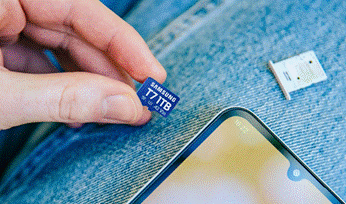
The T7 microSD Card is an everyday expandable storage for light gamers, intermediate creators and daily users who continue to accrue data across their devices. With massive capacities of up to 1TB[1], read speeds of up to 170MB/s[2], and extensive compatibility, the T7 microSD Card is designed to support daily storage needs across devices such as smartphones, laptops, tablets and handheld gaming consoles, delivering a simple and dependable way to expand everyday storage.
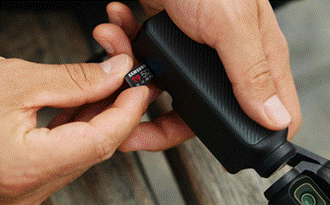
The T9 microSD Card is built for users who require relentless performance, such as gaming enthusiasts and professional creators who handle large data files and performance-intensive workloads. Featuring read speeds of up to 200MB/s2 and 6-proof protection for reliability and broad compatibility, the T9 microSD Card is designed to help users transfer large files quickly and work with confidence, especially on performance-driven devices such as drones and action cameras, as well as smartphones, laptops, tablets and handheld gaming consoles.
With the launch of T7 and T9 microSD cards, as well as the P9 Express, Samsung is evolving its removable storage portfolio from the previous microSD range—comprising of the EVO Plus, PRO Plus, and PRO Ultimate—into a streamlined lineup to unify the brand identity and align the brand experience across Samsung’s removable storage portfolio. The ‘T’ lineup signifies ‘Trustworthiness’ and ‘P’ for ‘Peace of Mind,’ highlighting the ample storage and powerful performance of Samsung’s removable storage offerings. The rebranding is expected to enhance consumer clarity, allowing for more intuitive and informed product selections based on specific user requirements.
The Samsung T7 microSD Card is offered in 128GB, 256GB, 512GB, and 1TB options1, while the T9 microSD is offered in 128GB, 256GB, and 512GB1. Manufacturer’s suggested retail prices for T7 microSD Card (MSRP) are set at RM209 for the 128GB, RM335 for the 256GB, RM663 for 512GB and RM1,325 for the 1TB model. T9 microSD Card starts at RM263 for the 128GB, RM413 for the 256GB and RM833 for the 512GB model, available to consumers from April 14, 2026. Availability may vary by market.
In conjunction with the 5.5 promotion, consumers who purchase a T9 microSD Card will be entitled to a complimentary exclusive Juno Blindbox, a special edition figurine that represents a memory-keeping persona, while stocks last.
| Samsung T7│T9 microSD Card Product Specifications | |||||||
| Product | T9 microSD Card | T7 microSD Card | |||||
| Form Factor | microSDXC™ | ||||||
| Capacity1 | 128GB | 256GB | 512GB | 128GB | 256GB | 512GB | 1TB |
| Interface | UHS-I SDR104[3] / UHS-I DDR200[4] with Samsung microSD Reader | ||||||
| Dimensions | 15 x 11 x 1 (mm) | ||||||
| Weights | Approximately 0.25g (Card Only) | ||||||
| Speed Class | U3, V30[5], A2[6], Class 10 | U3, V30, A2, Class 10 | |||||
| Sequential Read Speed2 | Up to 200MB/s | Up to 170MB/s | |||||
| Sequential Write Speed | Up to 130MB/s | – | |||||
| Certification | FCC (IC), CE (UKCA), VCCI, RCM | ||||||
| Warranty | Limited 3-year warranty[7] | ||||||
For more information, including warranty details, please visit https://www.samsung.com/sg/memory-storage/memory-card/ and the Samsung Product Warranty Information page: https://www.samsung.com/sg/support/warranty/.
[1] 1GB=1,000,000,000 bytes. Actual usable storage capacity may vary. User capacity measured with SD Formatter 3.1 tool with FAT file system.
[2] 1.8V Signaling, Frequency up to 208 MHz, up to 104MB/sec, Max Current Consumption 800mA (varies by test conditions)
[3] 1.8V Signaling, Frequency up to 208 MHz, up to 200MB/sec, Max Current Consumption 800mA (varies by test conditions)
[4] Video Speed Class means sustained video capture rates of 30MB/s (V30), which enable supporting real-time video recording to UHS Bus interface products. Transfer speeds may vary by host device.
[5] Application Performance Class means Min Random Read 4000 IOPS (A2), Random Write 2000 IOPS (A2), and Sustained Seq. Write 10MB/s (A1, A2), which makes app performance faster. Performances may vary by host device.
[6] (T7 microSD Card) Performance results are based on internal testing conditions. Stated performance was achieved using Samsung T7 microSD Card with Samsung microSD Card Reader (ver 3.0) in a controlled environment. Actual read/write speeds may vary depending on user environment.
(T9 microSD Card) Performance results are based on internal testing conditions. Stated performance was achieved using Samsung T9 microSD Card with Samsung microSD Card Reader (ver 3.0) in a controlled environment. Actual read/write speeds may vary depending on user environment.
[7] Warranties provided herein do not extend to any use of the product for or with continuous recording instruments or any other write-intensive devices, including without limitation security cameras, surveillance systems, dashboard cameras, black box cameras, internet protocol/network cameras, continuous recording set top box devices and continuous data logging devices like servers, dedicated devices for benchmarking test, the primary drive for certain devices and any other excessive uses.